 Add to Chrome
 Add to Firefox
 Add to Edge
Mind Your Margin and Boundary: Are Your Distilled Datasets Truly Robust?
May 20, 2026
Dataset distillation (DD) compresses a large training set into a small synthetic set for efficient training, but most DD methods optimize only clean accuracy and leave robustness uncontrolled. Recent robust DD methods improve robustness, yet they often suffer from a poor accuracy-robustness trade-off because they (i) treat all adversarially perturbed examples uniformly, despite robust risk being dominated by near-zero robust margins, and (ii) do not explicitly increase inter-class separation in the decision boundary where attacks concentrate. We present Contrastive Curriculum for Robust Dataset Distillation (C$^2$R), a framework that couples an attack-aware curriculum with a contrastive robustness objective. From a robust-margin perspective, we derive a perturbation score that approximates each sample's robust hinge, enabling a curriculum that prioritizes the smallest-margin adversaries that most directly drive robust error. In parallel, a class-balanced contrastive robustness loss enforces adversarial invariance while explicitly widening boundary separation across classes. Experiments on CIFAR-10/100, Tiny-ImageNet, and multiple ImageNet-1K subsets under six attacks show that C$^2$R achieves the best robust accuracy, outperforming prior robust DD by $2.8$% on average.

Fixed Anchors Are Not Enough: Dynamic Retrieval and Persistent Homology for Dataset Distillation
Feb 27, 2026Decoupled dataset distillation (DD) compresses large corpora into a few synthetic images by matching a frozen teacher's statistics. However, current residual-matching pipelines rely on static real patches, creating a fit-complexity gap and a pull-to-anchor effect that reduce intra-class diversity and hurt generalization. To address these issues, we introduce RETA -- a Retrieval and Topology Alignment framework for decoupled DD. First, Dynamic Retrieval Connection (DRC) selects a real patch from a prebuilt pool by minimizing a fit-complexity score in teacher feature space; the chosen patch is injected via a residual connection to tighten feature fit while controlling injected complexity. Second, Persistent Topology Alignment (PTA) regularizes synthesis with persistent homology: we build a mutual k-NN feature graph, compute persistence images of components and loops, and penalize topology discrepancies between real and synthetic sets, mitigating pull-to-anchor effect. Across CIFAR-100, Tiny-ImageNet, ImageNet-1K, and multiple ImageNet subsets, RETA consistently outperforms various baselines under comparable time and memory, especially reaching 64.3% top-1 accuracy on ImageNet-1K with ResNet-18 at 50 images per class, +3.1% over the best prior.
Beyond Random: Automatic Inner-loop Optimization in Dataset Distillation
Oct 06, 2025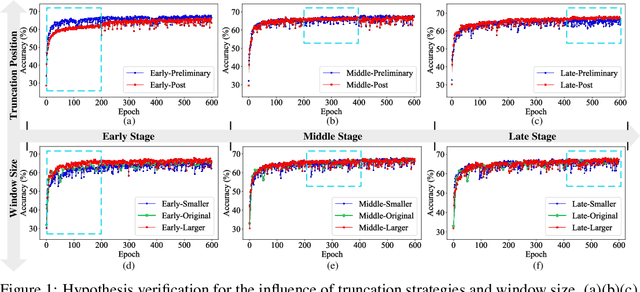
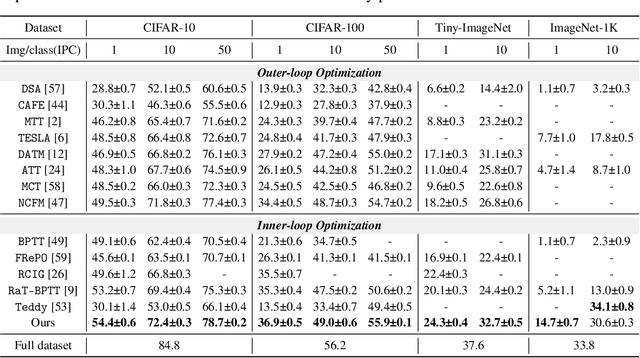
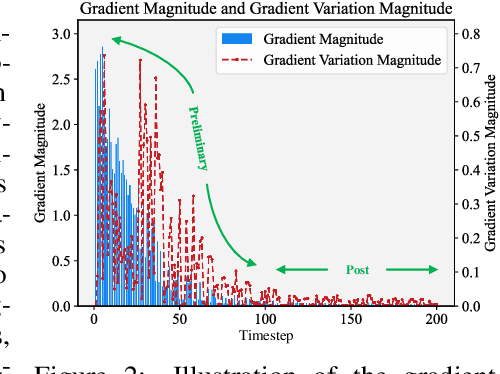
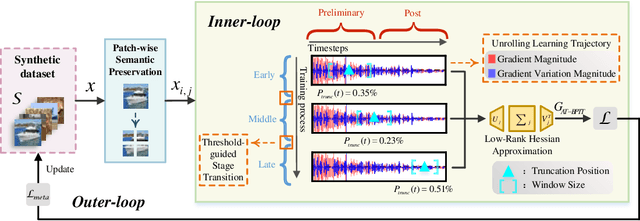
The growing demand for efficient deep learning has positioned dataset distillation as a pivotal technique for compressing training dataset while preserving model performance. However, existing inner-loop optimization methods for dataset distillation typically rely on random truncation strategies, which lack flexibility and often yield suboptimal results. In this work, we observe that neural networks exhibit distinct learning dynamics across different training stages-early, middle, and late-making random truncation ineffective. To address this limitation, we propose Automatic Truncated Backpropagation Through Time (AT-BPTT), a novel framework that dynamically adapts both truncation positions and window sizes according to intrinsic gradient behavior. AT-BPTT introduces three key components: (1) a probabilistic mechanism for stage-aware timestep selection, (2) an adaptive window sizing strategy based on gradient variation, and (3) a low-rank Hessian approximation to reduce computational overhead. Extensive experiments on CIFAR-10, CIFAR-100, Tiny-ImageNet, and ImageNet-1K show that AT-BPTT achieves state-of-the-art performance, improving accuracy by an average of 6.16% over baseline methods. Moreover, our approach accelerates inner-loop optimization by 3.9x while saving 63% memory cost.